

Airline loyalty teams do not have a data problem. They have an attention problem.
Walk into any loyalty operations review and count the dashboards. Revenue, redemption, status movement, card acquisition, partner activity, award availability, upgrade utilization, sentiment, app engagement, service failures, ancillary purchases. Every one of those metrics matters. The trouble is that they do not all matter equally, at the same time, for the same reason, and most reporting environments show everything while prioritizing almost nothing.
That is instrumentation, not intelligence.
A cockpit contains hundreds of instruments, but no pilot stares at all of them with equal intensity for the entire flight. The flight deck is designed around a different principle: organize information around what matters now. Altitude, heading, fuel, weather, deviation from plan. The instruments serve the decision, not the other way around.
Airline loyalty needs a flight deck, not a bigger wall of charts.
The program has outgrown the airline
There was a time when airline loyalty could be understood almost entirely through flights. How often does the member travel? What cabin? What status? How many miles redeemed? Those questions still matter. They just no longer describe the business.
Look at what a modern airline program actually connects: the airline, the credit card, alliance partners, hotels, rideshare, dining, retail, airport experiences, Wi-Fi, vacation packages, everyday spending. A member’s relationship can be growing while she is not flying at all, and it can be weakening while the traditional flight dashboard still makes her look like a star.
Alaska Airlines’ launch of Atmos Rewards shows how broad the operating challenge has become. The program unified Mileage Plan and HawaiianMiles, connects members to more than 30 airline partners and over 1,000 destinations, ties loyalty to credit cards, Lyft, hotels, and free Starlink Wi-Fi, and is introducing something no global airline has offered before: members will choose whether they earn by distance traveled, price paid, or segments flown.
As a customer proposition, that is compelling. As an intelligence problem, it is enormous.
Three earning models do not just create three customer choices. They create three different lenses on customer value. A member who chooses distance behaves differently from one who chooses price. A customer who earns status through card spend has a different relationship with the airline than one who earns it in seat 4C every Tuesday. A member engaging through rideshare, dining, and hotels may be becoming more valuable even as flight frequency declines.
Which signals indicate growth? Which indicate substitution? Which indicate a customer quietly preparing to leave? A dashboard can show the numbers. Program intelligence has to explain what they mean.
Loyalty is too economically important for retrospective management
Delta’s most recent quarter puts the stakes in plain numbers. Loyalty and related revenue grew 19 percent. American Express remuneration reached $2.4 billion, for the quarter, with the airline expecting roughly $9 billion for the year and card spend growing double digits for the seventh consecutive quarter.
Clearly, this isn’t a side program generating incremental engagement; loyalty is a second income statement, connecting customer preference, card economics, partners, travel products, and the core airline.
And yet much of loyalty management still runs on a retrospective clock. The partner report is reviewed after the month closes. The campaign is evaluated after it ends. The status trend appears after the qualification year. The service failure is connected to churn after the member has stopped flying. The award anomaly is investigated after the inventory is gone.
The organization eventually learns what happened, but eventually isn’t an operating model.
In the first article of this series, I argued that a great insight arriving too late is not an insight. It is an explanation. Nowhere is that more expensive than in a business where the loyalty program now moves billions.
Status can hide the movement underneath it
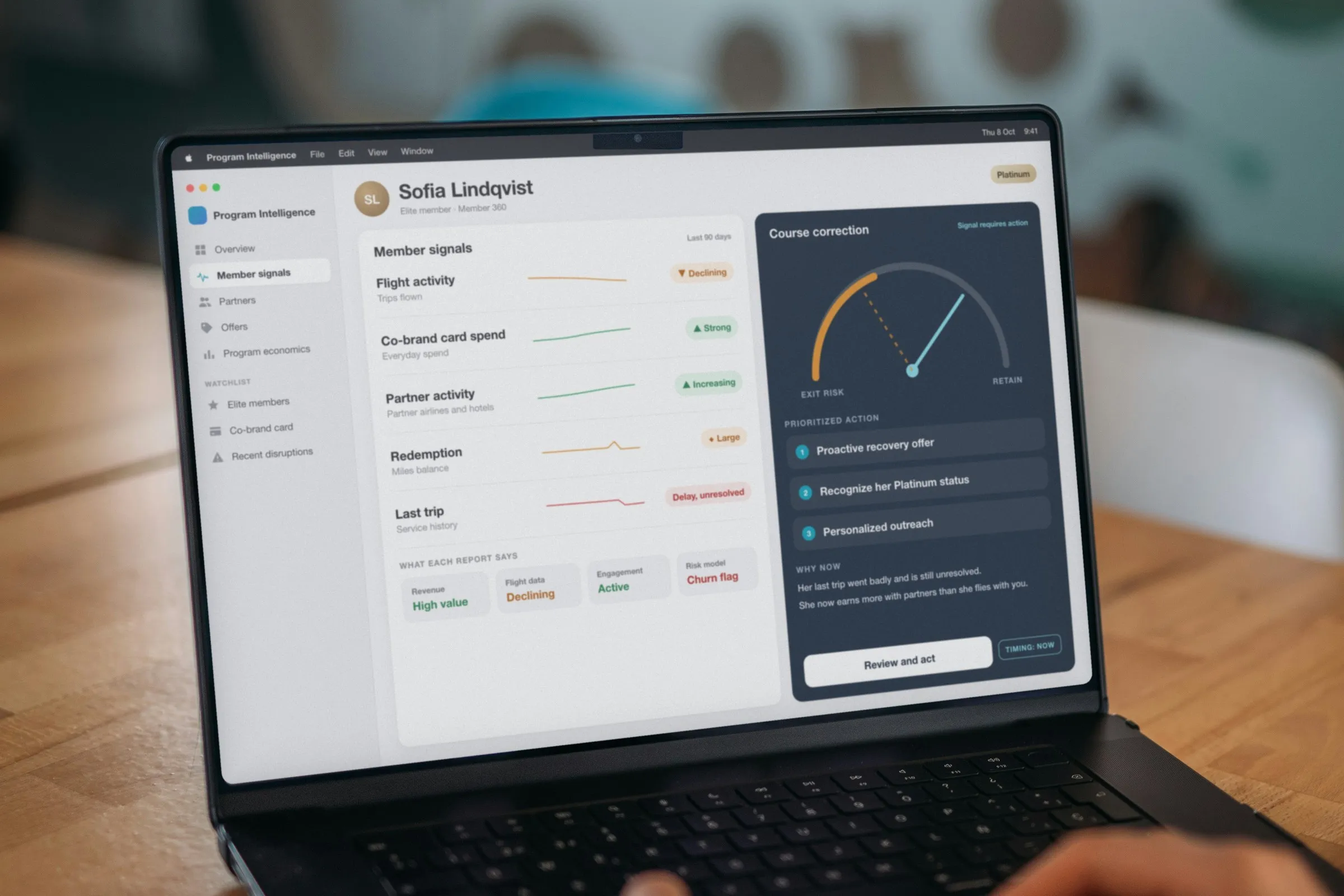
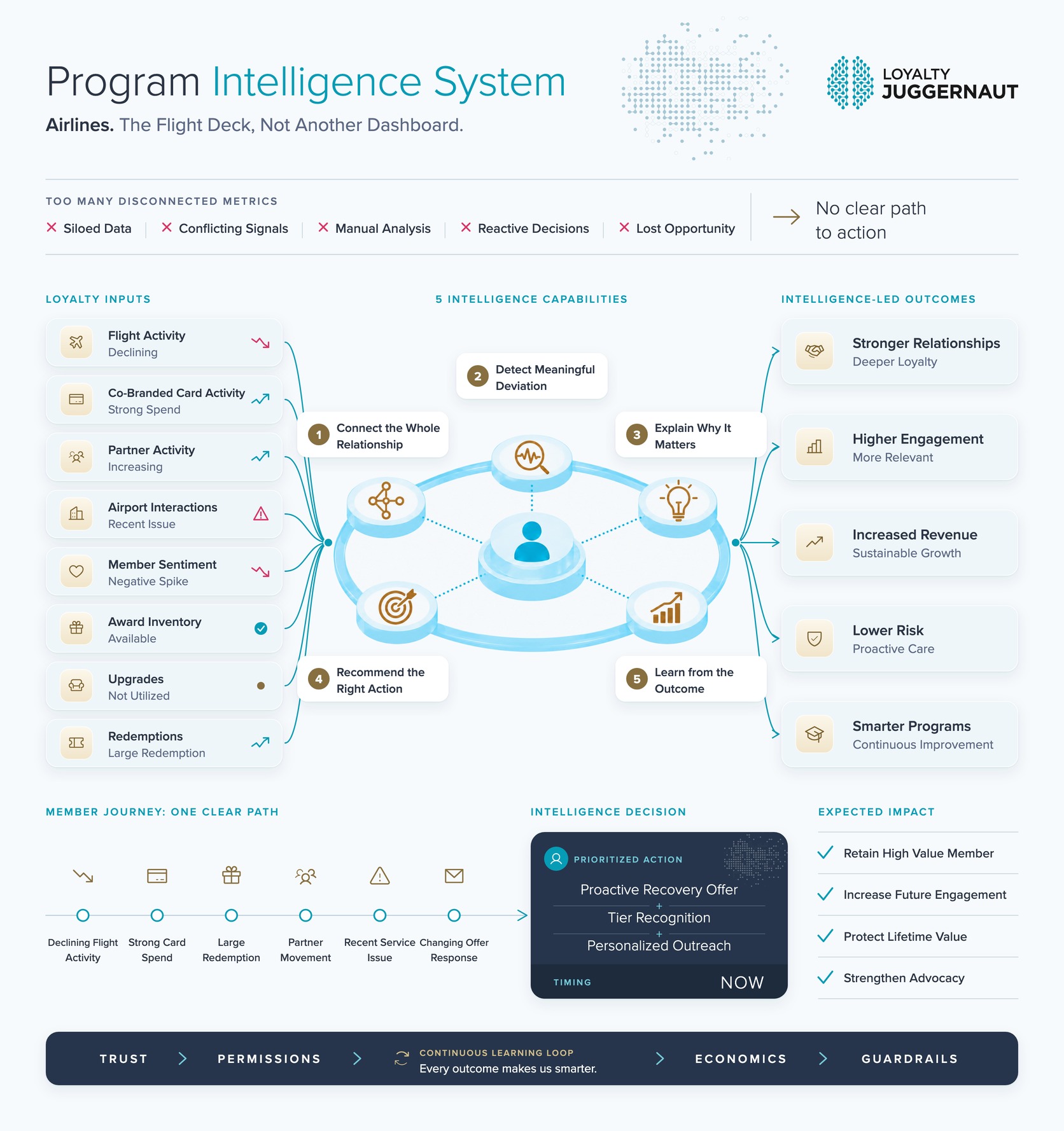
Picture a longtime elite member. Her flight activity is declining, but her co-branded card spend remains strong. She recently redeemed a large share of her mileage balance. She has started booking more alliance-partner flights. She had a poor service experience during her last delay. She still opens the emails but has stopped responding to upgrade offers. Last month, she linked a rideshare partner.
Ask four systems about her and you will get four answers. The revenue view says she is highly valuable. The flight view says she is declining. The engagement view says she is active. The risk model says she is a churn candidate. All four are correct, and none of them is the answer.
Her status describes what she earned. Her signals describe what is happening. Maybe her travel needs changed. Maybe the network no longer serves her as well, and partner activity is what is keeping the relationship alive. Maybe that big redemption was an expression of trust, or the first step of an exit. She might need recognition, or service recovery, or no commercial offer at all.
This member needs the airline to understand the pattern, not another generic “next best offer.” Program intelligence is the ability to connect those signals before deciding what to do.
Reporting starts with a metric; intelligence starts with a decision.
Most dashboards are built by asking: what should we measure? A program intelligence system starts from a different question: what decisions must we make?
The change sounds small, but it isn’t.
A program leader does not just need to know that redemption increased. She needs to know where, driven by which members, using which rewards, and whether it improved engagement, created a liability issue, or reflected a devaluation scare, a promotion, or a genuine change in customer intent. The same discipline applies everywhere: partner revenue can grow while the customer proposition weakens. Enrollment can rise while activation falls. Card acquisition can accelerate while long-term cardholder quality erodes. Award bookings can climb while satisfaction drops, because members cannot find the rewards they actually want.
A metric is the beginning of an investigation, not a conclusion.
Five capabilities separate intelligence from reporting
- Connect the whole relationship. Flight behavior, card activity, partner engagement, service interactions, redemptions, digital behavior, sentiment, and program economics in one place, not because every decision needs every data point, but because the system must know which context is relevant.
- Identify meaningful deviation. A 10 percent decline does not mean the same thing for every member, route, partner, or season. The question is not “did something change?” It is “did something change enough, for this customer or business area, to justify action?”
- Explain why the signal matters. Alerts without context create work, not value. “Redemption increased” is an alert. “Redemption increased among high-value cardholders after award availability improved, producing stronger forward bookings without abnormal liability pressure” is intelligence.
- Recommend the right level of action. Some signals require a member intervention. Some require a partner conversation, a rule change, or a financial review. Some require monitoring and nothing more. The system should direct attention where attention can change the outcome, not manufacture urgency.
- Learn from the decision. Did the intervention improve flight frequency? Did the recovery preserve the relationship? Did the new benefit change behavior, or simply reward members who would have acted anyway? Closed-loop measurement tells us what happened. Incrementality tells us what we caused.
This is where the GRAVTY Program Intelligence System fits
Within the GRAVTY Agentic Universe, the Program Intelligence System brings program health, member behavior, partner performance, sentiment, benchmarking, and economics into a connected decision layer. Not to generate more dashboards, but to change what each role can see and do.
At its center is GRAVTY Agentic AI Compass: a single, always-on module that houses a team of specialized agents. They share context, so a signal one agent finds becomes an action another takes. Ask your loyalty program anything, and get strategy, not just statistics. In practice, the five capabilities above are not aspirations. Each one is an agent assignment.
1. Connect the whole relationship
- Data Fusion Agent, unifies your uploaded business documents, partner results, and campaign notes with live program data into one intelligence layer, so context travels with every question.
- Analytics Agent, turns a plain-English business question into the database queries and visualizations behind it. Decision-ready KPIs in seconds, no SQL, no analyst queue.
- External Intelligence Agent, connects internal loyalty KPIs with outside-in signals: competitor benchmarks, sentiment trends, and public data, so decisions reflect more than internal numbers.
2. Identify meaningful deviation
- Timeseries Anomaly Agent, watches your metrics over time and flags unusual spikes, drops, and deviations the moment they emerge, the award anomaly investigated before the inventory is gone, not after.
- Group Analysis Agent, analyzes group-specific KPIs to reveal which cohorts are growing or stalling. Three earning models become three readable lenses, distance, price, and segment cohorts each judged against their own normal.
- Benchmarking & Program Score Agent, an industry lens on your program, scoring its health against industry standards and peer performance, so a 10 percent move is read in context, not in isolation.
3. Explain why the signal matters
- Program Analysis & Recommendations Agent, proactively monitors program health with multi-step reasoning, turning it into narrative insights and an execution-ready action plan, not just another chart.
- Multi-Threaded Insights Agent, investigates many analytical paths at once, trends, anomalies, sentiment, audits, and segmentation, to surface the connected story a single analyst would miss.
- Sentiment Agent, analyzes how members and partners truly feel across surveys, feedback, and public channels, turning the service failure into an early signal instead of a churn autopsy.
4. Recommend the right level of action
- Agentic AI Recommendation Agent, reads live KPIs, behavioral signals, and business context to surface the single highest-impact next action, a member intervention, a partner conversation, a rule change, or watchful waiting.
- Audience Agent, describe the audience in a sentence and it builds, previews, and ships a production-ready segment instantly, so acting on the insight does not wait for a build cycle.
- GRAVTY AI-Agentic Summary, distills the entire program into a crisp, executive-ready story, and distills the member too: the agent at the gate sees the whole relationship, not one transaction.
5. Learn from the decision
- Audit Agent, summarizes program and sponsor audit activity, what changed, who changed it, when, and whether it needs attention, turning week-long reviews into seconds and closing the loop on every intervention.
- Competitor Analysis, analyzes rival loyalty strategies, offers, benefits, and market positioning, so an Atmos-scale market move is something you benchmark against, not something that catches you off guard.
- Guardrails & Safety Bias Agent, keeps every interaction safe and on-topic, focused on your loyalty program, so the intelligence, and the actions it recommends, can be trusted.
Read the elite member’s pattern through that lens. The Timeseries Anomaly Agent flags her redemption spike. The Sentiment Agent connects the delayed flight to her silence on upgrade offers. The Group Analysis Agent shows she is part of a wider cohort shifting to partner earn. The Recommendation Agent weighs it and suggests recognition and a service make-good, not a discount. That is the pattern understood before the exit, not explained after it.
And because the Universe is connected, intelligence does not stop at insight. Compass hands the finding to the systems that act: the Personalization System (GRAVTY AI-Individualize, AI-Recommend, AI-Price) turns it into member-level relevance; the Growth & Retention System (GRAVTY AI-Retain, AI-Forecast) scores the drift and projects the value at risk; the Trust & Risk System (GRAVTY AI-Sense, AI-Trust) protects miles, awards, and program economics in real time; the Productivity & Workflow System (GRAVTY Pulsar) moves the team from question to brief in the flow of work; and the Commerce & Experience System (Agentic Commerce Assistance, GRAVTY AI-Scan, AI Translate) makes the response show up wherever the member is, the app, the card, the partner, the airport. One universe. Shared intelligence. Always on.
The loyalty executive sees where the program is moving, not just where it has been. The partner manager understands which relationships are creating value and which are merely creating volume. The marketer can tell an opportunity from noise. The airport agent understands the member standing in front of them: the whole relationship, not one transaction.
The organization moves from “what happened?” to “why does it matter, and what should we do now?” That is program intelligence. Not replacing judgment, but improving where judgment is applied.
The member should feel the intelligence without ever seeing the machinery
No customer wants to know that the airline connected twelve data sources and ran five models. She wants the airline to notice that her needs changed. She wants a relevant recovery when something goes wrong, benefits she can actually use, and recognition that reflects the whole relationship, consistently, across the airline, the card, the app, the partner, the airport, and the service line.
She should feel that the airline has more understanding, not more data.
Airline loyalty will be won by the carrier that recognizes which signal requires a course correction while there is still time to change the destination, not the one with the most metrics.