

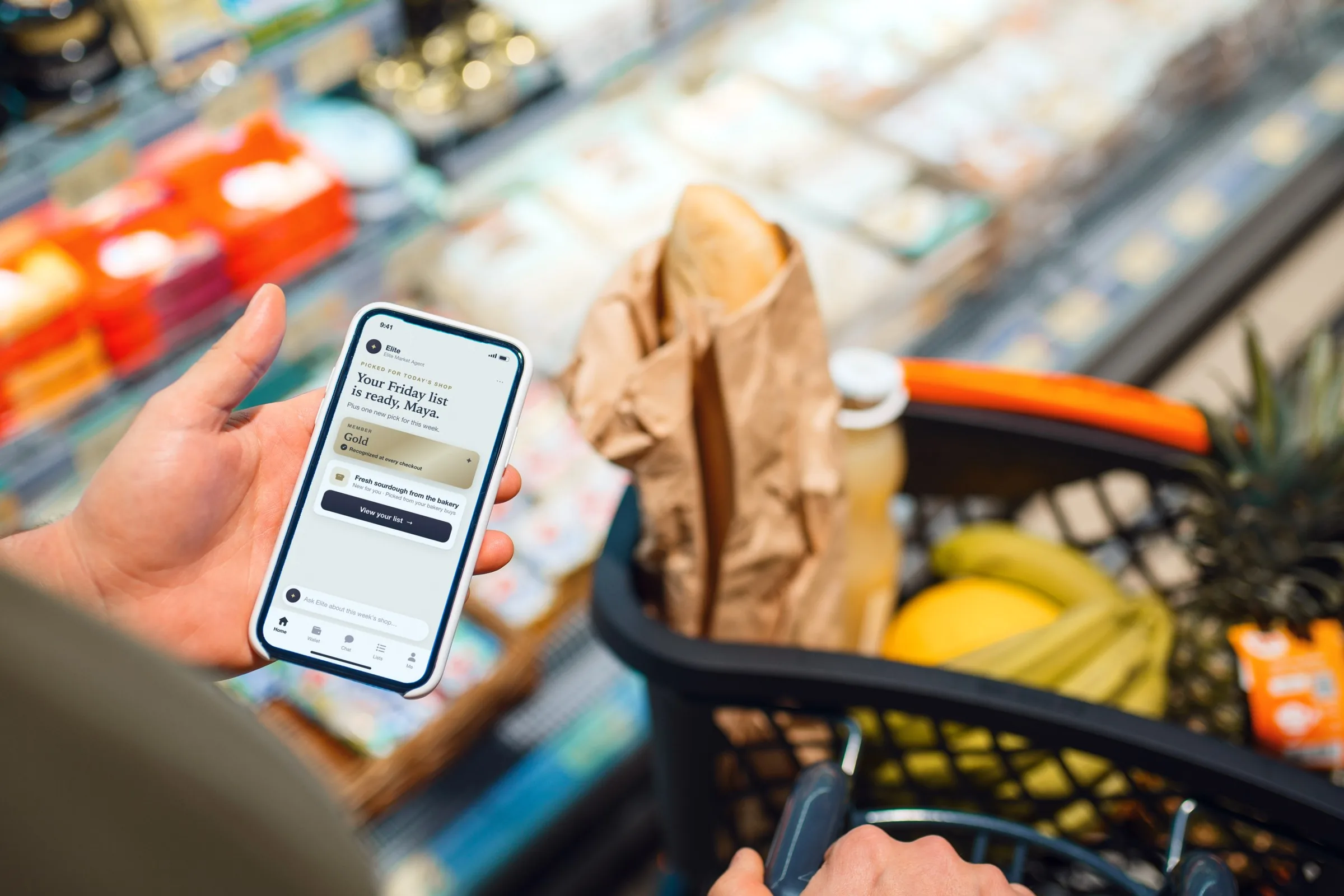
Most grocery retailers do not need another customer segment. They need a better decision about the customer standing inside it.
Take two members who look identical on every report: same frequency, same store, similar spend, overlapping categories, same responsive channels. One is a deeply committed shopper who would value recognition, convenience, and help discovering something new. The other is quietly shifting spend to a competitor and needs a deliberate reason to return. One responds to a category challenge; the other would have bought the category anyway and needs no incentive at all. One needs savings. The other needs inspiration.
Traditional segmentation puts them in the same box and sends them the same coupon. The data is individual. The decision is not.
Personalization is not targeting. It is decisioning.
Loyalty creates one of the most valuable data assets in the enterprise
Few industries see customer behavior as completely as grocery. Through the loyalty relationship, a retailer can connect purchases and categories, frequency and recency, basket composition, channel and fulfillment preferences, promotion response, earn and redemption behavior, digital interactions, private-label participation, brand switching, partner-funded activity, service interactions, and how all of it changes over time.
When those signals are used within the rights, permissions, terms, and governance established with the customer, they are an extraordinary strategic advantage, and not one the industry should apologize for. The member identified herself. The retailer established a value exchange. She receives savings, rewards, convenience, and more relevant experiences; the retailer earns the right to understand the relationship more completely and serve it better.
That is the promise. Here is the problem: most organizations invest heavily to recognize the individual and then continue speaking to her as part of a group. They capture customer-level data, analyze customer-level behavior, calculate customer-level value, then build a segment, attach an offer, and send the same treatment to three hundred thousand people.
Segmentation was a necessary compromise. It is no longer a necessary one.
Segmentation is not bad. It was the practical answer to an operating limitation: no marketing team could manually design a separate proposition for five million members, so it created manageable groups: high value, at risk, family shopper, promotion sensitive, health focused, digital first. Those groups moved the industry beyond mass communication and improved relevance, campaign design, and resource allocation.
But every segment is an approximation. The larger it is, the more variation it hides. The smaller it gets, the harder it becomes to operate, until adding segments stops adding value and starts adding rules, versions, approvals, and complexity. At that point the marketer has not achieved individualization. She has built a more complicated campaign machine.
Mass individualization is not infinite segmentation. It is the ability to make a decision at the individual member level without manually building a separate campaign for every person.
The market is already moving from offers to objectives
Tesco regularly delivers personalized digital coupons and rewards to more than nine million customers, has run AI-driven Clubcard Challenges for audiences of up to seven million, and has partnered with Adobe to push toward near-real-time, one-to-one relevance across its digital channels.
Kroger’s January announcement goes a step further into agentic territory. Its new shopping assistant, built with Google Cloud, moves from a single customer instruction through inspiration, product selection, offer application, and basket creation, grounded in Kroger’s actual assortment, pricing, and availability. A request like “I want to make vegan tomato soup” becomes a guided recipe and a one-click ingredient list, with relevant savings applied along the way. Albertsons is piloting its own assistant with OpenAI. The category is not experimenting at the edges; it is racing.
Notice what these systems have in common. They do not start from “which promotion should we show?” They start from “what is the customer trying to accomplish, and how should the retailer help?” That is the shift, and it demands a very different decision engine underneath.
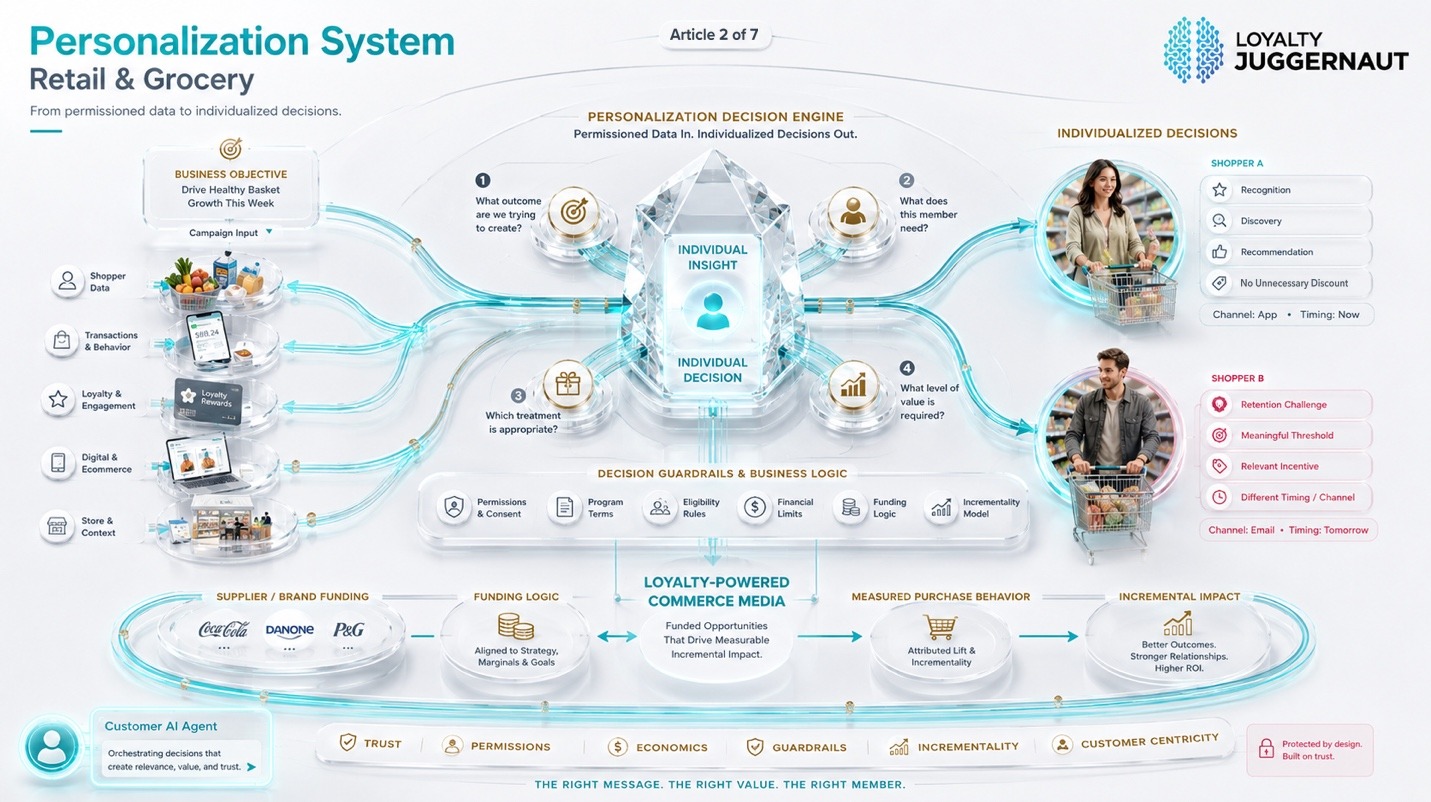
One personalized interaction contains four decisions
What the customer experiences as a single recommendation requires the enterprise to decide several things well:
- What outcome are we trying to create? Introduce a category, build a replenishment habit, prevent decline, grow private-label participation, move the customer to a more valuable channel, reward loyalty, help complete a mission, improve margin. Without a clear objective, personalization is just offer distribution: it may produce a response without producing growth.
- What does this member need? The answer should begin with the relationship, not the inventory of available promotions. What has changed? What has she stopped doing? Which categories are expanding or declining? What does she consistently ignore? What happened after the last intervention? The purpose of data is not to make the profile more impressive. It is to make the next decision more accurate.
- Which treatment is appropriate? A recommendation, a challenge, a threshold offer, bonus currency, a recipe, a replenishment reminder, a partner-funded reward, recognition, education, or no intervention at all. That last option matters. A customer already highly likely to purchase needs no incentive. Giving everyone something is not personalization; sometimes the best decision preserves the investment for a customer whose behavior can actually be changed.
- What level of value is required? Two members can deserve the same offer type at very different thresholds. A $20-over-four-weeks challenge may represent real incremental behavior for one member and sit comfortably below another’s normal spend, rewarding activity that would have happened anyway. One threshold is easy to administer. It is rarely equally meaningful. The goal is not to give a customer less because she is worth less; it is to align the investment with the behavior the program is trying to create.
Response is not incrementality
This is the distinction that separates commercially serious personalization from busy personalization. The customer most likely to use an offer is not always the customer who should receive it. A devoted shopper may have a sky-high response probability, and would have purchased anyway. Another member may respond less often but create far more incremental value when she does.
Clicks, activations, and redemptions describe activity. They do not prove the treatment changed behavior. The stronger decision weighs expected incremental value: the probability the action changes behavior, times the financial value of that change, minus the incentive, channel, and operational cost of creating it, with longer-term effects like retention and category adoption in view.
Closed-loop measurement tells us what happened. Incrementality tells us what we caused. Personalization becomes commercially meaningful the moment it can tell the difference.
From retail media to Loyalty-Powered Commerce Media
Now extend the same discipline to supplier partnerships. The old model starts with the audience a manufacturer wants to reach: pick a segment, deliver impressions and coupons, measure aggregate response.
The loyalty-powered model starts with the relationship. The retailer uses permissioned member data to identify shoppers with a credible opportunity for trial (excluding those who already buy the product, distinguishing likely switchers from category entrants from lapsed buyers), then determines the right offer, challenge, threshold, and timing for each, delivers it through owned and paid channels, and connects exposure to actual customer-level purchasing. The manufacturer gets measurable growth. The retailer gets category performance and funding. The member gets something selected because it has a reasonable chance of being useful.
That is more than retail media. It is Loyalty-Powered Commerce Media.
The scale is already proven. Kroger Precision Marketing builds its advertising business on verified purchase data from more than 62 million loyalty households, and measures success the same way this article argues personalization should be measured: incrementality, comparing exposed and unexposed households to isolate what the investment actually caused. The customer relationship stops being merely a source of demand. It becomes a platform for creating, funding, and measuring new value.
The operating model is the real constraint
Almost every sophisticated personalization idea is technically possible today. The constraint is operating it. A traditional workflow needs an analyst to find the audience, a data scientist to build the model, a marketer to pick the treatment, a merchant to approve products, a supplier team to confirm funding, finance to validate economics, a channel team to build the activation, a loyalty team to configure rules, a creative team to write it, and another analyst to measure it. That works for a quarterly campaign. It cannot make millions of changing member-level decisions across thousands of products and continuous behavior.
The future is coming faster than the operating model. This is the same gap I have traced through this whole series (the space between knowing and doing), and agentic systems exist to close it: continuously interpreting signals, evaluating available actions, applying eligibility and permission rules, forecasting outcomes, calculating expected value, executing or recommending, and learning from the result.
That does not mean handing an AI model the freedom to invent customer treatments. It means encoding the organization’s strategy into an operating system. The agent works inside data-use permissions, consent choices, program terms, eligibility rules, regulatory requirements, combinability rules, brand standards, financial thresholds, funding limits, and human approval requirements.
So the better question is not “can AI choose an offer?” It is: can the enterprise define its strategy, permissions, economics, and operating rules clearly enough for the system to make the right decision, repeatedly, at scale?
This is where the GRAVTY Personalization System fits
The Personalization System within the GRAVTY Agentic Universe turns customer intelligence into individual relevance: one campaign that adapts to every customer, instead of thousands of variants that adapt to none. Its core agents are built around exactly the four decisions above, so each decision is an agent assignment, not a workflow.
Decision 1: What outcome are we trying to create?
- Agentic AI Recommendation Agent (from GRAVTY Agentic AI Compass), reads live KPIs, behavioral signals, and business context to surface the highest-impact objective for the moment: introduce the category, build the habit, prevent the decline, protect the margin.
- Audience Agent, describe the audience in a sentence, “members with credible trial opportunity in plant-based, excluding current buyers,” and it builds, previews, and ships a production-ready segment instantly. The objective becomes an audience without a build cycle.
Decision 2: What does this member need?
- GRAVTY AI-Individualize, generates true 1:1 offers at scale, dynamically predicting the best reward rate, spend threshold, and product category for each member. Not one offer for a segment: a personalized value equation for every shopper.
- Compass signal agents, the Timeseries Anomaly, Sentiment, and Group Analysis Agents feed the relationship view: what changed, what she stopped doing, which categories are expanding or declining, and what happened after the last intervention.
Decision 3: Which treatment is appropriate?
- GRAVTY AI-Recommend, delivers the next-best offer, product, brand, and category to each member, powered by machine learning and behavioral signals, a recommendation, a challenge, a recipe, a partner-funded reward, or recognition.
- Offer Testing Agent, automatically generates test cases and simulates results for every offer before it goes live, which is also how “no intervention at all” earns its place: if the simulation shows she buys anyway, the investment is preserved for a member whose behavior can change.
Decision 4: What level of value is required?
- AI-Price, dynamically sets award-offer pricing for each member in real time, keeping redemption cost aligned with business value. The $20 challenge stretches one member and is recalibrated for the one it would merely subsidize.
Proving incrementality, not just response
- Offer Testing Agent + closed-loop learning, simulated lift, liability, and conversion probability before launch; measured incremental outcomes after; each result feeding the next decision, so the system learns what it caused, not just what happened.
- Audit Agent, keeps the complete trail of what changed, who changed it, and when, so every treatment decision is explainable to finance, partners, and the program’s own governance.
Powering Loyalty-Powered Commerce Media
- Audience Agent + GRAVTY AI-Recommend, build the trial-opportunity audiences (switchers vs. category entrants vs. lapsed buyers) and match the manufacturer-funded offer to each member and moment.
- GRAVTY AI-Scan, automates receipt capture and validation with AI-powered OCR and LLMs, rewarding purchases even outside owned channels and cutting manual review by up to 80 percent, closing the loop from exposure to verified customer-level purchase, the currency of incrementality.
Operating at scale, inside the rules
- GRAVTY Pulsar, uses generative AI to build complete loyalty offers, rules, creatives, and communication templates from a simple business prompt in seconds, collapsing the ten-role workflow into a working conversation.
- Guardrails & Safety Bias Agent, keeps every interaction safe and on-topic, working inside the permissions, consent choices, program terms, financial thresholds, and approval requirements the organization defines. The strategy is encoded; the agent operates within it.
Run the two identical members from the opening through that machinery. AI-Individualize reads the first shopper’s expanding categories and steady baskets and proposes discovery and recognition, no discount required. It reads the second’s quiet decline, the Group Analysis Agent confirms she is part of a competitive-shift cohort, and AI-Recommend pairs a win-back challenge with a threshold AI-Price sets above her drifting spend, not below her old one. Same reports. Different decisions. That is the difference between targeting and decisioning.
And because the Universe is connected, the Personalization System never decides in a vacuum. The Program Intelligence System supplies the why behind the signal; the Growth & Retention System (GRAVTY AI-Retain, AI-Forecast) flags who is drifting and projects the value at stake; the Trust & Risk System (GRAVTY AI-Sense, AI-Trust) protects the economics every offer draws on; the Productivity & Workflow System (GRAVTY Pulsar) keeps the marketer in command of it all conversationally; and the Commerce & Experience System (Agentic Commerce Assistance, GRAVTY AI-Scan, AI Translate, AR Engagement Tool) delivers the decision wherever the customer is deciding, the app, the shelf, the assistant, the receipt. As grocery’s agentic assistants race ahead, Agentic Commerce Assistance is what makes the loyalty program itself agent-ready, so the right offer is present inside the conversation where the basket is being built.
Together they move the marketer from one campaign for everyone, to segments for groups, to intelligent member-level value propositions operating continuously at scale. Not uncontrolled automation. Not personalization for its own sake. A disciplined system for making better customer and commercial decisions.
The customer should feel the result, not see the machinery
Customers do not need to know how many signals were evaluated or which budget funded the reward. What they should experience is simpler: fewer irrelevant promotions, offers that reflect how they actually shop, challenges that are achievable, rewards they value, and help completing the mission they are already on.
The customer should never feel that the retailer has more data. She should feel that the retailer has more understanding.
The next era of grocery personalization will not be won by the retailer with the most data. It will be won by the retailer that most consistently turns its data into the best permissible decision, for the customer, the business, and the relationship.