



Sometime in the next year, one of your most valuable customers will make a significant purchase from you, or from your competitor, without visiting your website, opening your app, or reading a single email.
She will say something like this to an assistant:
“Book me the best flight to London. Stay inside company policy. Factor in my miles and my status. Pick a hotel where my benefits actually matter. Arrange the airport transfer. Don’t book anything nonrefundable without asking me.”
She did not compare rewards tables. She did not check point balances across three programs. She did not click through a partner portal or hunt for the promo code buried in Tuesday’s email.
She expressed intent, preferences, constraints, and permission. Her agent did the work.
Now the uncomfortable question: which brand wins that decision?
The one with the richest rewards table? Only if the value of that relationship can be found, understood, trusted, compared, and acted upon in the moment, by a machine negotiating on her behalf.
The app may no longer be the front door. The relationship still has to be.
This is not a forecast. The rails are being laid now.
For years, “AI in customer engagement” mostly meant content. Write the email. Build the audience. Recommend the offer. Useful, but that is AI helping someone think. The shift underway is AI helping something happen.
In January, Google introduced the Universal Commerce Protocol, an open standard connecting AI agents, retailers, commerce platforms, and payment providers from discovery through post-purchase service, co-developed with Shopify, Etsy, Wayfair, Target, and Walmart. Applying loyalty rewards inside agentic checkout is explicitly on the roadmap.
In June, Visa announced a strategic collaboration with OpenAI to bring its payment network, tokenization, agent identification, authorization, and fraud monitoring into AI-initiated commerce, with consumer-defined guardrails like spending limits and approval thresholds built in from the start.
And Visa’s own research this spring found that nearly 40% of Americans have already made a purchase they would not otherwise have considered, because an AI agent or tool put it in front of them.
Agents are not just executing demand. They are shaping it.
This is not the market building a better chatbot. It is the market building a new layer between customer intent and commercial action. Loyalty cannot afford to be an afterthought inside that layer.
The fear is that agents kill loyalty. The opportunity is the opposite.
The worry is understandable: if an agent can compare hundreds of options in seconds, every decision collapses into a race to the lowest price.
Possible. Not inevitable.
An agent optimizes for whatever it is told to optimize for: price, yes, but also quality, convenience, status, benefits, service history, refund policies, trusted partners, and the customer’s own rules. The real question is whether your brand can make relationship value visible and machine-actionable.
That is precisely what loyalty was built to do. Loyalty provides the three things agentic commerce runs on:
- Identity. Who this customer is, and what context the brand may responsibly use.
- Value. What she has earned, what she is eligible for, and what would make this decision meaningfully better for her.
- Permission. What the company or the agent may do, under what conditions, with what level of customer control.
Most enterprises already own the pieces. The problem is where the pieces live. The loyalty system knows her status. Commerce knows what she browsed. Service knows she complained. The partner team knows she used the co-branded card. Finance knows what her points are worth. Marketing knows which emails she ignored.
Everyone has a piece of the customer. No one is managing the relationship.
Status still matters. It just can’t carry the relationship alone.
For decades, status was useful shorthand (Gold, Platinum, Elite), a clean way to recognize historical value and differentiate benefits. That still works. Starbucks just proved it: the reimagined 2026 program reintroduced Green, Gold, and Reserve tiers with accelerating earn rates and richer experiences, and let members link accounts with Delta SkyMiles and Marriott Bonvoy. The program entered the relaunch at a record 35.5 million active U.S. members.
But look closer at what the strongest programs are actually doing. Delta’s partnership with Uber linked more than 1.4 million SkyMiles members in its first several months, then went beyond earning miles on rides to piloting an express drop-off lane at LaGuardia that removes real friction from the actual journey.
That distinction matters. The old partnership model added another place to earn. The better model uses the relationship to make the experience better.
Status tells you where the customer has been. Signals tell you what is happening now. A drop in frequency. A service failure. An abandoned search. A benefit that goes unused month after month. A sudden redemption. A shift from premium to entry-level. Even the absence of an expected behavior.
A customer can hold elite status while the relationship quietly deteriorates. She can still have points while her trust declines. She can look active on the dashboard while moving her spending elsewhere. If all you see is the status, you miss the moment.
The problem is not data. It is operating lag.
Loyalty technology has climbed three stages. First, administration: enrollment, points, tiers, partners, liability. Then visibility: dashboards for growth, redemption, engagement, economics. Then prediction: churn risk, fraud patterns, next best action.
Each stage made loyalty more capable. And most organizations are now stuck in the gap between the third stage and the one that matters: action.
They know a valuable customer is drifting; the intervention ships six weeks later. They know the offer is underperforming; the campaign runs until the budget is gone. They spot the fraud pattern after the points are gone. They read the partner’s results in the quarterly report.
A great insight that arrives too late is not an insight. It is an explanation.
Agentic loyalty closes the space between knowing and doing.
Agentic loyalty is not a chatbot bolted onto a loyalty platform, auto-generated campaigns, or an algorithm handed unlimited authority over customers, currency, and money.
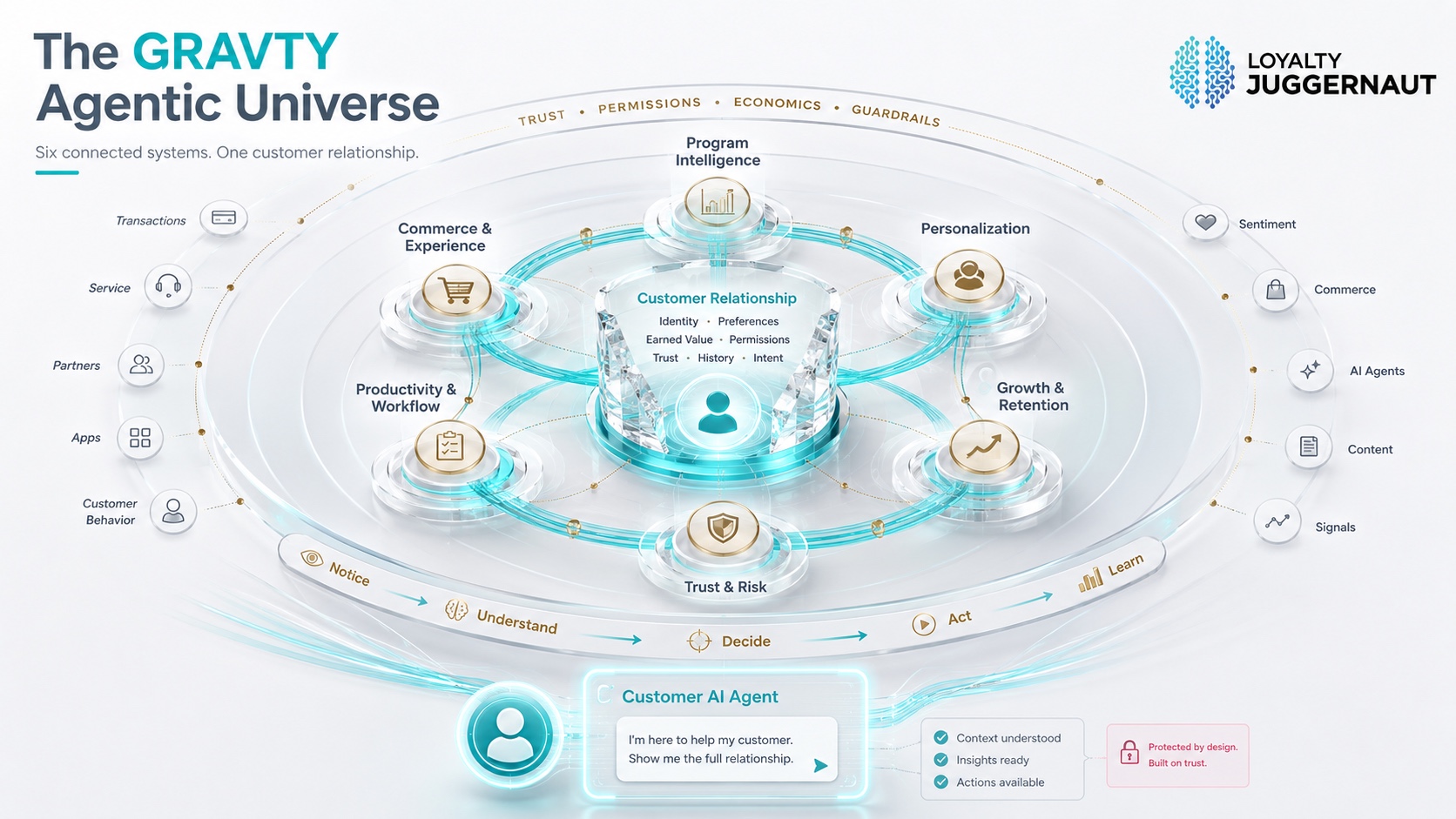
At its best, an agentic loyalty system does five things. It notices: a meaningful change, opportunity, or risk. It understands: pulling together customer, program, partner, commercial, and emotional context. It decides: the right next action or value exchange. It acts: recommending, preparing, or executing within clearly defined boundaries. And it learns: measuring the outcome so the next decision is better.
That last verb is the point. The objective is not more activity. It is better decisions.
Because AI scales whatever you feed it. A weak loyalty strategy connected to AI becomes a faster discount machine. A poor value proposition becomes a more efficiently distributed poor value proposition. Bad data becomes a confident wrong answer.
Which is why trust, economics, governance, permission, and human judgment belong in the conversation from the beginning, not after the pilot, not after the complaint, not after the financial exposure shows up.
Automate the task. Protect the relationship.
Five questions to ask before you ask which agent to buy
- Which signals matter enough to change an action? Not every click deserves a response. The discipline is distinguishing meaningful movement from noise.
- Does the decision understand the relationship, or only the transaction? The latest purchase is useful. History, preferences, service experience, partner activity, economics, and current intent, together, are what drive a good decision.
- What is the right value exchange? It will not always be a discount. Sometimes it is recognition, convenience, access, flexibility, service recovery, or simply the removal of effort.
- What may the system do, and what still requires a person? Agentic does not mean unsupervised. Define authority, approvals, financial limits, escalation, explanations, and customer controls up front.
- Can we prove the action created value? Member sales are not incremental growth. Closed-loop measurement tells us what happened. Incrementality tells us what we caused.
Customers will delegate the work. They will not delegate trust.
The enthusiasm around agentic commerce makes adoption feel inevitable. Trust is not.
Visa’s consumer research across the U.S., Australia, and New Zealand found that about one in three consumers expect to use AI shopping assistants regularly, and roughly two-thirds would use them to save time and find better prices. But approximately 85% want control over the data their agents can access, and nearly nine in ten want transparency into how agent decisions are made.
Customers are not asking technology to take over the relationship. They are asking it to remove the work while leaving them in charge.
That is a loyalty issue. The customer should know why the recommendation was made and which benefit was applied. She should be able to set the boundaries and be protected when something goes wrong. She should never feel that the company has more data. She should feel that the company has more understanding.
From one agent to an Agentic Universe
This is the thinking behind the GRAVTY Agentic Universe. We do not believe the future of loyalty is one all-purpose assistant floating above the program. Loyalty is too interconnected, and too economically consequential, for that. It requires a connected system of specialized intelligence: six agentic systems, more than 30 AI agents and tools, one operating model.
- Program Intelligence, so teams understand what is happening, why it matters, and where attention is required. Powered by GRAVTY Agentic AI Compass and its team of specialized agents, Program Analysis & Recommendations, Analytics, Benchmarking & Program Score, Timeseries Anomaly, Sentiment, Audit, Data Fusion, Multi-Threaded Insights, External Intelligence, Competitor Analysis, and more. Ask your loyalty program anything, and get strategy, not just statistics.
- Personalization, turning customer understanding into an individualized value exchange. GRAVTY AI-Individualize, AI-Recommend, AI-Price, and the Audience Agent: one campaign that adapts to every customer instead of thousands of variants that adapt to none.
- Growth and Retention, surfacing opportunity and risk early enough to change the outcome. GRAVTY AI-Retain scores every member’s churn risk, AI-Forecast projects the value at stake, and Group Analysis and Competitor Analysis reveal where the movement is coming from, so you know who is drifting, and why, before they leave.
- Trust and Risk, protecting identity, currency, economics, permissions, and responsible operation. GRAVTY AI-Sense watches the program in real time, AI-Trust scores and stops fraud as it happens, and the Guardrails & Safety Bias and Audit Agents keep every automated action explainable, compliant, and reconstructable. The foundation everything else stands on.
- Productivity and Workflow, moving marketers from question to answer and from recommendation to execution. GRAVTY Pulsar, the in-platform GenAI concierge, with the Conversational AI, Offer Testing, Data Fusion, and Multi-Threaded Insights Agents: from question to answer to brief, in seconds.
- Commerce and Experience, bringing loyalty into the actual moment of intent, across apps, stores, associates, partners, checkouts, and AI-assisted commerce. Agentic Commerce Assistance makes the program agent-ready, GRAVTY AI-Scan rewards purchases even outside owned channels, and AI Translate, the AR Engagement Tool, and GRAVTY AI-Agentic Summary put the relationship wherever the customer, or her agent, shows up.
The systems share context, so a signal one agent finds becomes an action another takes. Which is how the Universe staffs the five verbs above. It notices through AI-Sense, AI-Retain, and the Timeseries Anomaly Agent. It understands through Compass: Data Fusion, Sentiment, Analytics, Multi-Threaded Insights. It decides through the Agentic AI Recommendation Agent, AI-Individualize, and AI-Price. It acts through Pulsar, Audience Agent, Agentic Commerce Assistance, and AI-Scan, inside the boundaries Guardrails & Safety Bias enforces. And it learns through the Offer Testing Agent’s simulations, closed-loop measurement, and the Audit Agent’s complete record, so the next decision is better than the last.
And the three things agentic commerce runs on are exactly what the platform makes machine-actionable. Identity: Agentic Commerce Assistance recognizes the member, with permission, in whatever interface her agent arrives through. Value: her status, points, benefits, and eligibility in structured, actionable form, with AI-Price weighing what the redemption is actually worth to her. Permission: consumer-defined boundaries enforced by the Guardrails & Safety Bias Agent, every action scored by AI-Trust, everything reconstructable by the Audit Agent.
Go back to the traveler who opened this article. When her agent arrives, a GRAVTY-powered program shows up: her miles and status legible to the machine negotiating on her behalf, her “benefits that actually matter” surfaced by AI-Recommend, her nonrefundable rule held as a hard boundary, and the whole decision explainable afterward. Did your loyalty program show up? With the Agentic Universe, it answers.
In the six articles that follow, I will take each of these systems into a different industry: airlines, retail, hospitality, financial services, telecom, restaurants, and coalitions. Not because those industries operate the same way. They do not. But the management problem travels. Every loyalty organization must understand the relationship, decide where value gets created, recognize risk, act while the moment still matters, and prove the action made the business and the relationship stronger.
The next era of loyalty will be won in the space between signal and action
Agentic loyalty is not about handing the relationship to a machine. It is about shrinking the distance between what the customer is telling us and what the enterprise does about it.
Customers will not care what we call the architecture. They will notice whether the company remembered them. Found the value they earned. Fixed the problem. Saved them time. Protected their interests. Made the next interaction more useful than the last.
The winners will not be the companies with the loudest AI claims or the richest rewards tables. They will be the ones that understand customers well enough, act quickly enough, and create enough genuine value that the customer feels the difference, even when her agent is the one doing the shopping.