

The loyalty industry has a self-perception problem.
For decades, we’ve defined loyalty programs by their cost structures: the liability on the balance sheet, the breakage assumptions, the discount budgets. We’ve measured them by retention rates and redemption behaviors. We’ve justified their existence with customer lifetime value models that, honestly, most executives never fully trusted.
And while we were busy defending the program’s existence in board rooms, Walmart quietly built a $6.4 billion advertising business (growing at 41% year-over-year) powered almost entirely by what loyalty has always owned: first-party data and direct customer relationships.
Let that number sink in for a moment. It’s what we let slip away by not paying attention.
If you don’t have time to read this article… here are the main takeaways:
- Loyalty data is your most underleveraged enterprise asset. Retail media has already proven the market will pay premium prices for what your program generates every day.
- The brands winning right now aren’t running loyalty programs. They’re running enterprise growth engines where emotional connection, first-party data, personalized experience, and media monetization all converge and compound.
- Loyalty performance management (LPM) is the operating discipline that closes the gap between what your program costs and what it’s actually capable of producing — financially, strategically, and relationally.
- The technology to do all of this exists today. The gap isn’t capability. It’s conviction.
The Shift That’s Already Happening With or Without You
Retail media is now a $179 billion market, growing at roughly 15% annually, and already accounting for nearly a quarter of all digital advertising spend globally. It is, at its core, a loyalty data monetization story.
Brands are paying premium CPMs for the ability to reach a specific shopper at a specific moment of intent, with a closed loop that ties ad exposure directly to a sale. No proxies. No wasted impressions. That level of precision only exists because of the loyalty relationship: the card swipe, the app check-in, the points redemption, the behavioral trail your members leave every time they engage.
The irony is painful: loyalty programs generate the data. Retail media monetizes it. And in most organizations, these two functions barely talk to each other.
Loyalty Has Always Been More Than a Points Program
Here’s the uncomfortable truth: most loyalty programs are significantly underperforming their own potential and the brands running them don’t fully realize it.
The best programs in the world aren’t winning because of their reward rates. They’re winning because they’ve made themselves indispensable: showing up in moments that matter, anticipating needs before the customer articulates them, and evolving from a program customers opt into… to a benefit customers can’t imagine living without.
But look at what’s happening across the industry. Touchpoints go unrecognized. Interactions outside the core transaction (a review, a referral, a social share, a lifestyle signal) vanish without generating a single point of data or a moment of member recognition. Partners sit underutilized, treated as earn accelerators rather than ecosystem builders that extend the program’s relevance into more of the customer’s daily life. Benefits get broadcast uniformly to millions of members who have wildly different motivations, spending patterns, and emotional triggers.
Over 70% of loyalty programs still deliver completely non-differentiated experiences: identical regardless of who the member is, how they live, or what they actually value. This is happening at a moment when brands have more behavioral data, more AI capability, and more permission to personalize than at any point in the history of marketing.
The programs breaking through are treating every touchpoint as a data moment, every partner as a relevance multiplier, and every member interaction as an opportunity to deepen an emotional connection that competitors cannot replicate. They’re not just rewarding transactions, they’re building a relationship architecture that makes the brand genuinely central to how customers live, spend, and make decisions.
That is what loyalty was always capable of. Most brands just haven’t gone there yet.
The Revenue Equation Nobody Is Talking About Loudly Enough
Let’s put some numbers on the table because this conversation needs to happen in the C-suite, not just in the loyalty team’s quarterly review.
Walmart’s advertising business now contributes roughly a third of the company’s operating income, with retail media margins running north of 70%. That entire machine is fueled by loyalty data — purchase signals, behavioral patterns, and member segments that brands cannot access anywhere else at that level of precision or intent. And that’s just one expression of what loyalty data can generate commercially.
The revenue opportunities hiding inside a well-run loyalty program are far broader than most operators recognize… and far more material than most CFOs have ever been shown:
· Ancillary revenue from partner integrations structured as true ecosystem plays rather than simple earn accelerators generates meaningful income streams while simultaneously making the program more relevant in more moments.
· Audience monetization is the revenue line almost nobody is managing with intention: loyalty segments layered with recency, frequency, spend value, and attitudinal data are among the most valuable targeting assets in digital advertising, and brands will pay significant CPM premiums to reach authenticated, permissioned, closed-loop audiences that convert.
· Recognized revenue tied to loyalty liability (how currency is structured, when it’s recognized, how partner-funded rewards are accounted for) can shift the financial profile of the program in ways that turn a cost center into a margin contributor without a single additional member joining.
· Innovative tech-enabled touchpoints remain perhaps the most overlooked opportunity of all: every unrecognized interaction is simultaneously a missed personalization moment and a missed data capture moment that would otherwise enrich audience segments, partner propositions, and a monetizable AI-driven personalization across the entire ecosystem.
The compounding effect of getting all this right is why the best programs stop looking like marketing costs and start looking like enterprise growth engines.
That’s the conversation loyalty leaders need to be walking into the boardroom ready to have.
The Agentic Commerce Reckoning
This is the part most retail loyalty operators aren’t ready for… and the window to get ahead of it is shorter than anyone is comfortable admitting.
AI agents are starting to make routine purchasing decisions on behalf of customers. Replenishment. Travel. Subscriptions. Grocery. The agent evaluates options and executes without the customer actively choosing in the moment. And here’s the uncomfortable reality for programs built around human emotional mechanics: the agent doesn’t feel status. It doesn’t experience reward anticipation. It doesn’t respond to a well-designed app or a clever subject line.
It calculates. And it routes the transaction to wherever structured, machine-readable value is highest.
Loyalty programs that haven’t translated their value into API-accessible, algorithmically optimizable signals will be invisible in this environment. And invisible in agentic commerce doesn’t mean the customer chose a competitor. It means the agent did… and the customer never knew it happened.
The programs that win will have agent-ready architectures: loyalty value, member status, real-time offers all accessible via API in formats agents can evaluate and act on. Your loyalty currency becomes a competitive selection variable, not just a retention mechanism. In this world, real-time offer APIs become mission-critical infrastructure. The behavioral data that agents generate (query patterns, comparison signals, timing behaviors) becomes a new predictive layer that enriches everything downstream.
There’s an emerging metric worth paying attention to: agent preference rate… how often does an AI agent, given a choice, route a transaction through your program? It’s measurable. It’s optimizable. And the brands building toward it now will have a compounding advantage as agentic commerce scales.
This battleground is almost entirely uncontested right now. That won’t last long.
The Playbook for What Comes Next
The organizations that will win the next decade in loyalty are the ones building what I call an enterprise growth engine, driven and optimized by loyalty performance management. Not a program. Not a department. An engine: with a P&L, a connected strategy, and multiple compounding revenue streams driving customer lifetime value.
Loyalty performance management is the discipline that makes this real. It means moving beyond measuring points issued and redemption rates, and instead managing loyalty as a business… optimizing for customer lifetime value, media yield, emotional engagement, and financial return simultaneously. It means every decision is measured against what it produces for the customer and what it produces for the enterprise.
Getting there requires rethinking some fundamentals.
First: Treat your loyalty segments like premium inventory. Your high-intent, high-frequency members are an audience worth pricing. Recency and frequency signals, layered with life-stage and behavioral overlays, represent the most valuable targeting data in digital advertising. Structure and price that accordingly.
Second: Build the bridge between loyalty and media. The data your loyalty program generates is the foundation of your retail media network. If those two functions are operating in silos, you’re leaving significant margin on the table. The first-party signals your members generate have commercial value that most retailers dramatically underestimate.
Third: Stop optimizing for the average customer. The power of modern AI and real-time decisioning is the ability to treat every member as a segment of one: personalizing not just offers but experiences, benefits, and communications in ways that reflect who they are and how they actually live. The technology to do this exists today. Deploying it is a strategic choice, not a technical limitation.
Fourth: Elevate loyalty to a board-level conversation. If Walmart’s ad business contributes a third of operating income and it’s built on loyalty data, your CFO and CEO need to understand what your loyalty asset is actually worth. Bring them the data. Make the connection explicit. Loyalty isn’t a line item in the marketing budget… it’s an enterprise asset that deserves enterprise-level investment, governance, and ambition.
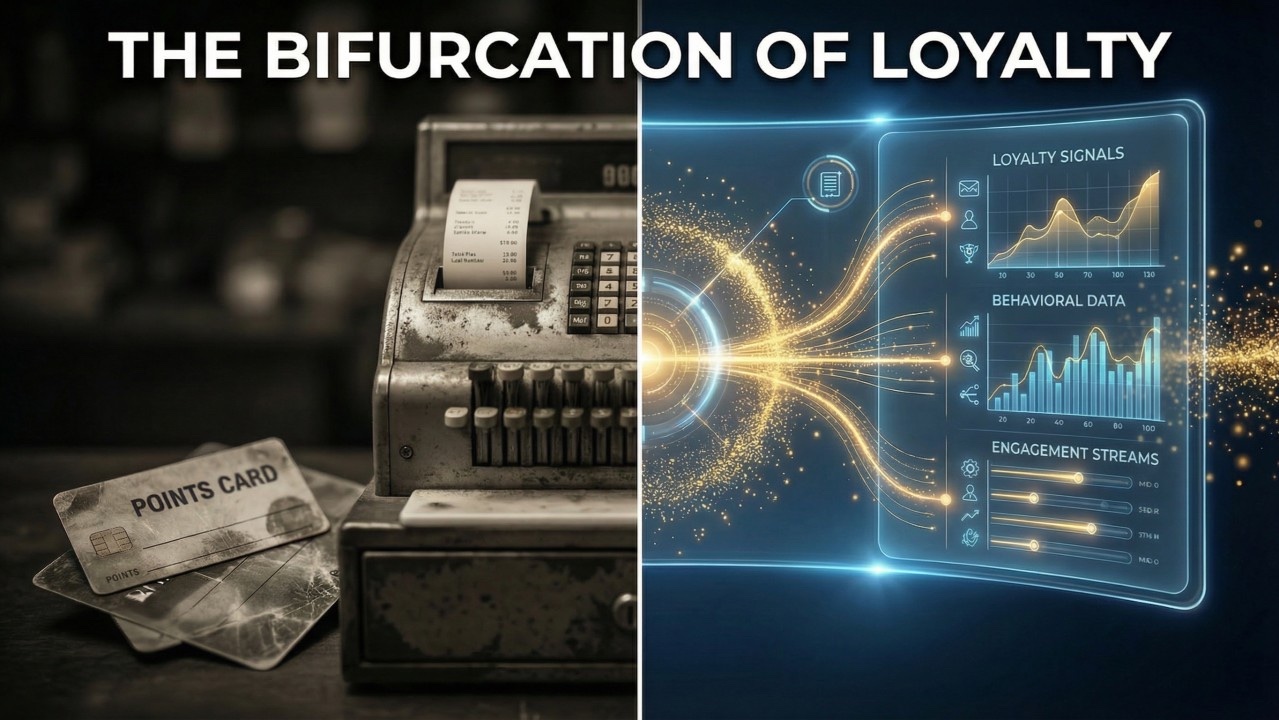
The Industry Is Splitting in Two — And the Gap Is Getting Uncomfortable
The loyalty landscape is bifurcating and the distance between the two sides is growing faster than most people inside legacy programs want to admit.
On one side: programs built for a different era and still being run that way. Technology that can’t surface a real-time offer, can’t feed a retail media network, can’t respond to an AI agent query. Measurement frameworks still reporting redemption rates to leadership teams who stopped believing those numbers years ago.
These programs aren’t failing dramatically. They’re just becoming quietly irrelevant: bleeding engagement, leaving revenue uncaptured, and defending budget with metrics that no longer mean anything.
On the other side: a growing cohort that has fundamentally rethought what loyalty is for. Enterprise growth engines with media yield strategies, partner ecosystem economics, AI-driven personalization at scale, and API-first architectures already being built for the agentic commerce wave arriving right now. These programs show up in earnings calls as profit contributors. Their data assets appear on balance sheets. Their member relationships are generating revenue streams that didn’t exist five years ago.
Every market signal converges to create an authenticated, behavioral, emotionally resonant customer relationship is now among the most valuable assets in commerce. The brands on the wrong side of this divide are sitting on that asset today.
The question is whether they move fast enough to claim its value or watch someone else do it for them.