
In this article, I explore four things that matter right now:
- The effect agentic AI is (and will be) having on traditional loyalty roles
- A new framework—GUIDE—to capitalize on your years of experience
- How practitioners can augment their roles to stay relevant
- Emerging, high-demand roles shaping the next decade of loyalty
Part 1: The GUIDE Operating Model
When the ground is shifting, it’s easy to feel like you’re playing catch-up. Don’t. You still matter—and the AI evolution needs you at the helm.
Agentic AI isn’t a smarter autocomplete. It can plan, use tools and data, execute multi-step workflows, and coordinate with humans and other agents to deliver outcomes—not just answers. Think of it as moving from a chat window to an autonomous teammate wired into your stack.
As loyalty pros, we’ve always been accountable for deadlines, deliverables, and outcomes. That doesn’t change—it evolves. We spend less time “doing,” and more time selecting tools, guiding workflows, defining outcomes, approving outputs, and coaching teams.
A simple way to sort responsibilities:
- Humans set direction and governance. Define strategy, constraints, and what “good” looks like.
- Agents orchestrate and execute. They segment, select, test, and deliver—continuously.
- Tools provide capabilities. Your CDP, Loyalty Management System (LMS), ESP, POS, data warehouse, feature store, experimentation, and observability layer wire everything together.
Your career edge comes from moving up the stack: own the rules, constraints, and decisions; let agents handle assembly and iteration.
An Agentic Loyalty Management Methodology
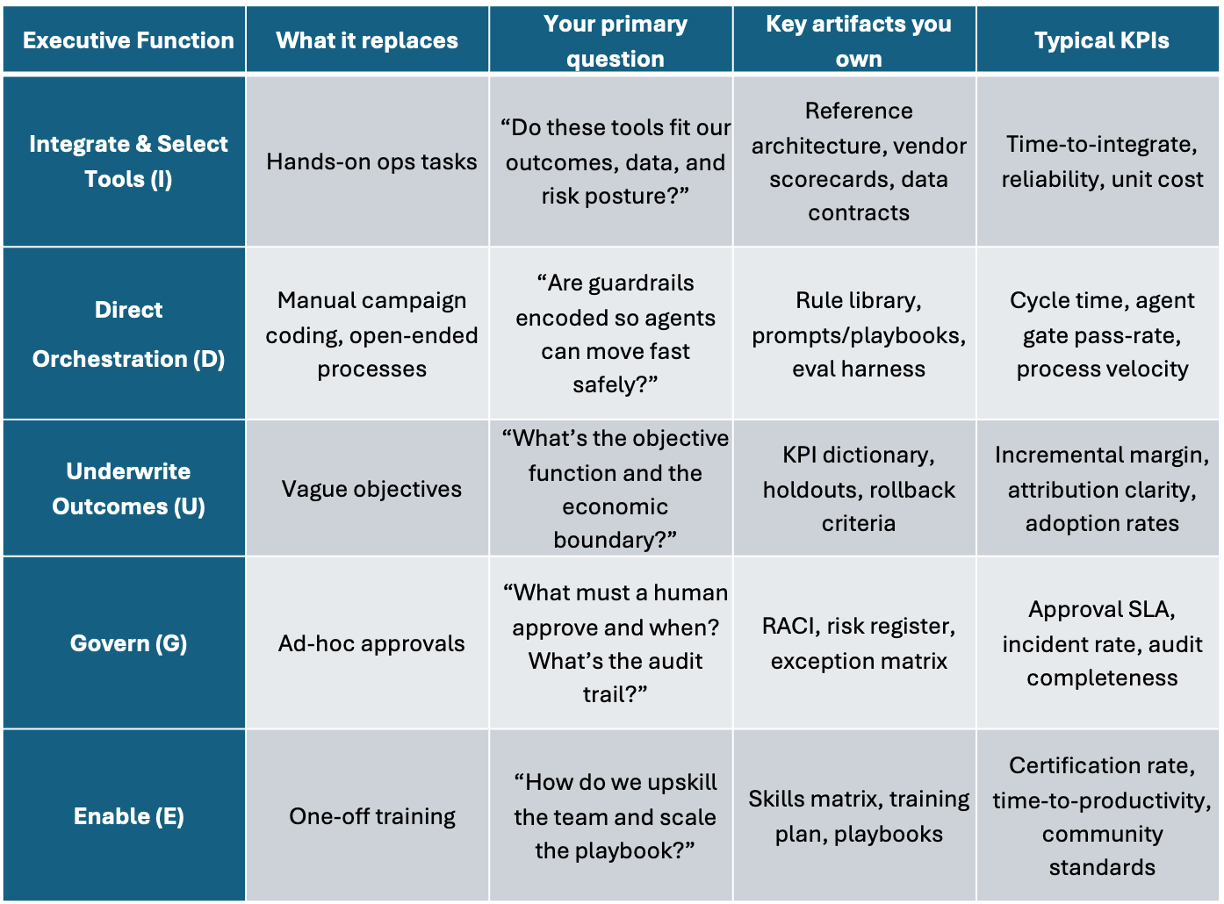
Use GUIDE to focus your leadership and keep the chaos in check:
For loyalty marketers stepping into the agentic-AI era, GUIDE is the operating system for your leadership—turning chaos into cadence. It helps you shift from doing to directing:
G — Govern (Approve & Assure) Own risk, compliance, and brand protection while speeding decision cycles. Approve launches and changes, set approval gates and escalation paths, and keep the audit trail.
U — Underwrite Outcomes (Define Targets & Economics) Translate strategy into machine-readable KPIs, budgets, and constraints. Define uplift, contribution margin, breakage, liability, guardrails, and holdouts.
I — Integrate & Select Tools (Curate the Stack) Choose and connect the LMS/ESP/CDP, data, decisioning, and agent orchestration layers. Own vendor selection, integration blueprints, data contracts, and security reviews.
D — Direct Orchestration (Set Up & Guide) Turn rules into executable workflows and keep agents on course. Implement guardrails, define approval gates, write playbooks/prompts, and prioritize the backlog.
E — Enable & Elevate People (Coach & Change-Lead) Lift capability and confidence. Train on experimentation, new tools, and data interpretation; reinforce AI safety; define career paths; codify playbooks.
As you put GUIDE into practice, watch for a few traps that quietly sabotage progress. Don’t spin up shadow IT agents without guardrails—every workflow needs clear policies, approvals, and the ability to track what happened. Treat agents as operators with SLAs, not interns you “try” and forget. Go-live only when a rollback plan exists; “we’ll fix it later” is not a strategy. And finally, translate goals into code—objectives, caps, KPIs, and holdouts—because in an AI-driven stack (tech and operators), if it isn’t encoded, it doesn’t exist.
GUIDE at a glance
David Andreadakis, Chief Commercial Officer: LJI , 2025
Part 2: Upgrading and Developing Your Role
A 90-day plan that works for any function
Change gets easier when you turn it into a sprint. This 90-day plan converts the GUIDE mindset into motion—no matter your title. The goal is simple: pick one valuable workflow, encode the rules, stand up a safe agent, and prove lift with real numbers. You’ll build momentum through small, visible wins, earn trust with telemetry and holdouts, and create a repeatable cadence your team can rally around. Start narrow, measure honestly, iterate fast—then scale what works.
- Pick one workflow with clear business value. Start small—reactivation, post-purchase cross-sell, or dormant win-back. These are measurable and highly visible. Prove value, then scale.
- Write the rules in plain language. Codify eligibility, offer policies, and frequency caps in a mutually readable doc or config. Transparency lets agents run fast—and lets humans sleep at night.
- Stand up your first agent—safely. Use explicit approval gates and telemetry that logs every action with reason codes. (Agent frameworks like LangChain can help.) Trust comes from traceability.
- Define how you’ll measure success. Agree on metrics—incremental lift, engagement, margin contribution—plus holdout design and rollback triggers. Bold moves are easier when the safety net is defined.
- Ship, observe, iterate. Go live. Watch the data. Hold a weekly “agent changes” review to share wins, misses, and surprises. Iteration is the new execution.
Part 3: Role by Role—Your Advantage and Opportunity
AI is coming for tasks, not for talent. The fundamentals of loyalty—brand judgment, economics, customer empathy, partner savvy—still belong to you. What changes is the cadence of the work and the tools in your hands.
Below, I’ve mapped each core role to two things you care about: how the work is shifting and the durable advantage you already have. Read yours as a blueprint for your 90-day plan—keep the edge, let the agents handle the repetition, and double down on the parts only you can do.
Campaign Manager (LMS/CRM/ESP)
- What changes: Agents sequence multi-channel campaigns, generate variants, enforce constraints, and auto-run experiments with real-time optimization.
- Your durable advantage: Brand judgment, promotional/regulatory nuance, partner sensitivities. You know when “on-brand” beats “stat-sig.”
Loyalty Program Manager (Strategy & P&L)
- What changes: Agents simulate earn/burn and liability, recommend rule tweaks, scan partner catalogs for value/fit, and flag abuse.
- Your durable advantage: Vision, risk appetite, partner relationships, and balancing member value with margin and brand purpose.
Analytics & Data Science (Loyalty)
- What changes: Agents accelerate data prep, feature generation, model selection, and monitoring; they run bandits and maintain evaluation harnesses.
- Your durable advantage: Problem framing, causal reasoning, experimental design—turning numbers into decisions others trust.
Experience, Personas & Journey Mapping
- What changes: Agents personalize journeys in real time, propose hypotheses, generate content/conversational flows, and monitor friction/churn signals.
- Your durable advantage: Empathy, qualitative insight, brand voice stewardship, and cross-team alignment.
Consulting (Program Design & Economics)
- What changes: Agents speed discovery and synthesis, produce structured alternatives, run quick scenario models, and assemble traceable client artifacts.
- Your durable advantage: Client trust, cross-silo synthesis, and change management.
Part 4: Emerging, High-Demand Roles in Loyalty
If you’re between roles and not seeing that perfect match, widen the lens. Companies are hiring for agentic-AI era roles that may look unfamiliar to anyone raised on traditional loyalty titles—and that’s good news. With a bit of targeted upskilling and by applying the GUIDE approach, your hard-earned judgment on brand, economics, and customer behavior becomes exactly what these teams need. In other words: you’re closer to the ideal candidate than you think.
- Agent Orchestrator / Automation Architect: Designs multi-agent workflows across CDP, LMS/ESP, POS, and wallets; owns safety and approval gates.
- Offer Policy Architect: Converts liability, margin, and fairness constraints into machine-readable rules agents must obey.
- Data Product Manager (Loyalty Signals & Features): Treats data as a product; curates features, sets data contracts, and enforces quality SLAs.
- Experimentation & Causal Lead: Designs uplift tests, sets holdouts, monitors drift, and audits agent decisions.
- AgentOps Engineer: Runs telemetry, evaluation, prompt/version control, and incident response so agents stay reliable and explainable.
- Context Engineer / Knowledge Manager: Maintains the corpora agents retrieve from—FAQs, T&Cs, partner catalogs, prior campaigns.
- Model Risk & Ethics Lead (Loyalty): Ensures governance, fairness, compliance, and audit trails specific to earn/burn and offers.
Conclusion: Be the Conductor, Not the Instrument
Agentic AI won’t replace loyalty professionals—it will replace repetitive tasks. The irreplaceable work—direction, governance, economics, and brand judgment—belongs to you. This is your moment to move up the stack, codify your expertise, and scale your impact through agents and new teammates.
Adopt GUIDE. Ship one workflow. Measure what matters. Teach your team. Do this, and you won’t just keep up—you’ll set the pace.