
Price is still secondary. Even now. Especially now.
AI didn’t change this important rule… It magnified it.
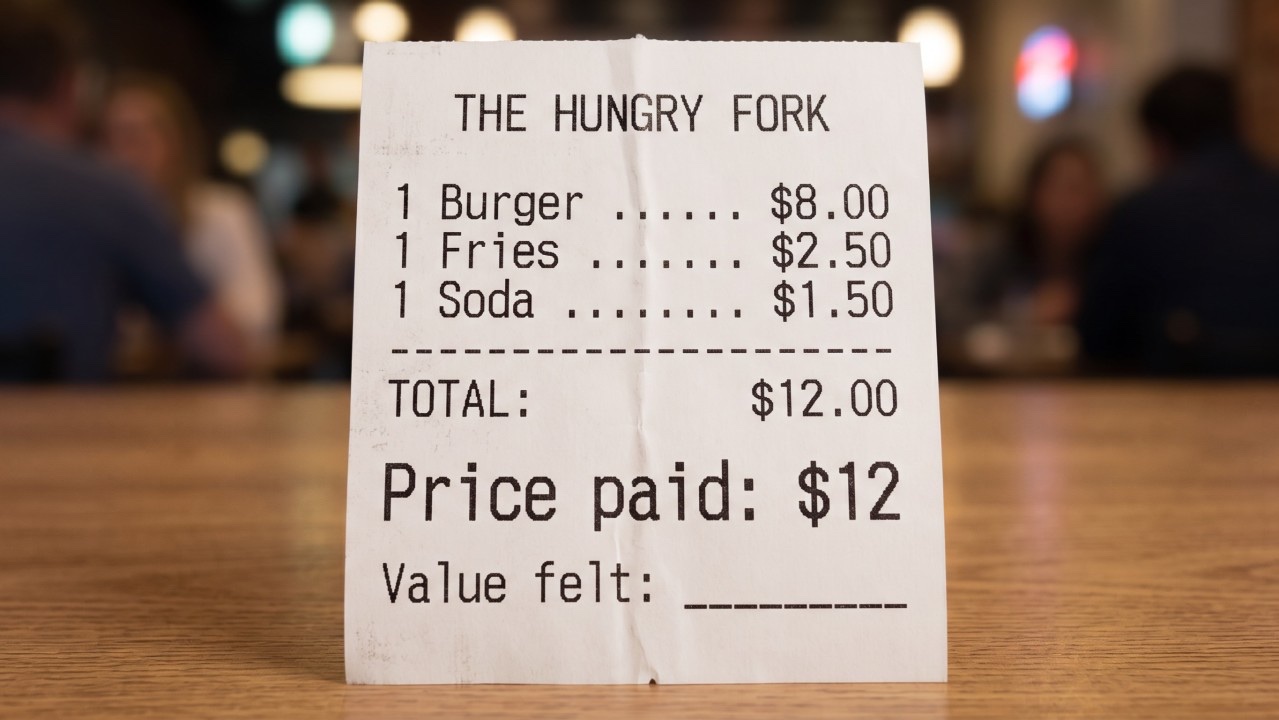
I often speak about how price is relative. How much is a soda worth? $2 in the office. $5 at the bar. $8 at the airport. $12 on the hotel rooftop at sunset. $18 at Disney. The soda didn’t change, but the experience changed a lot.
The same applies to a hotel room, a concert ticket, a haircut, a financial advisor, a doctor visit. Customers don’t buy on the sticker. They buy on total perceived value. Deloitte estimates up to 40% of perceived brand value lives outside the price tag, in service, quality, convenience, and loyalty. The soda math suggests that number is low by an order of magnitude.
Here is the tension AI introduces: Technology can absolutely lower cost. The harder question is whether it keeps the experience good enough to justify the price… or whether it quietly strips out the moments that made the price make sense in the first place.
Winning brands will use AI to remove waste centered around the experience. Lazy brands will use it to remove cost… and along with it, care. Customers will feel the difference and their wallets will follow.
Experience (Where AI earns its keep) is bigger than service
Most conversations about customer experience collapse into one word: service. That is too narrow. Experience is functional, emotional, and social all at once. I think of it as how hard the customer had to work, how they felt while they worked, and what the whole thing meant to them on the way out.
AI is excellent at the functional layer. It can assist on the emotional layer. It becomes dangerous the moment a brand asks it to replace the human, social moments that made a premium experience feel premium. Done well, AI makes the customer feel the company is working harder for them… not the other way around. Subtle difference. Huge consequence.
Before the sale. Narrow 300 options to 3. Rebook a traveler in 30 seconds. Schedule the appointment. Translate the jargon. Remember where the customer left off. In those moments, convenience becomes the experience. A retailer that uses AI to walk a confused shopper to the right running shoe does not need to be the cheapest. A bank that spots a fraud attempt and calmly walks the customer through it has created value before a human ever enters the room.
At the point of sale. AI can reduce the fear of making a bad call. Kahneman made this plain decades ago: people do not just chase gains… they feel losses about twice as hard. So a customer will sometimes value AI not because it saved a dollar, but because it prevented a regret. An AI assistant that cleanly compares insurance plans, explains a financing structure in plain English, or flags the right subscription tier is reducing risk. That offsets price. In the right category, it justifies a higher one. The customer is not just buying the product…They’re also buying confidence.
After the sale. The piece almost everyone skips. AI can keep creating value long after the card is charged. Think onboarding, usage tips, maintenance alerts, proactive service, a loyalty experience that actually feels like it knows the customer. Buyers remember the moment they paid as well as whether the decision still felt smart a month later. A fitness brand that adapts to progress, an appliance maker that helps a homeowner avoid the repair, a B2B platform that surfaces features the team already pays for but never uses… that’s not support, that’s making the original decision worth more over time.
Where AI will quietly cost brands money
Not all friction is bad.
Waiting on hold for 22 minutes is bad. Repeating an account number three times is bad. Digging through six menus for a return label is bad.
However, a thoughtful pause is not bad. Visible effort is not bad. Reassurance is not bad. Human discretion is not bad. The sense of being known is not bad. Relishing the moment a decision has been made is not bad. These are human moments.
Sometimes the steps are the product.
The labor illusion. Harvard research found that when customers can see effort being made on their behalf, perceived value rises. In some experiments, people preferred a slightly slower service where the work was visible over an instant result where it was not. A black-box AI answer can be fast and still feel thin. Compare it with a concierge who says, “I looked at three options, ruled out two because of your kids’ schedule, and held the best one.” Same outcome. Completely different sense of value.
Resolution is not care. A problem can be technically solved and emotionally mishandled. Some moments are not questions, they’re feelings in disguise. A cancelled honeymoon. A denied insurance claim. A fraud alert. A frightening medical result. A retirement decision. A missed flight to a funeral. The real question underneath the question is almost always, “Am I safe?” or “Is somebody actually with me on this?” AI can support the answer. It should never be the answer. And in high-stakes categories, part of reassurance is explanation. In reality, a fast answer no one understands does the opposite of build confidence.
The peak-end rule. People disproportionately remember the emotional peak of an experience and the ending. Not the average. Not the middle. Which means a service interaction can be technically fast and still leave a bad memory if the ending is cold, abrupt, or opaque. A chatbot that handles 90% of the issue and botches the handoff on the last 10% has optimized for efficiency at the exact moment the customer is forming their memory. That is not a win. That is damage dressed up as cost savings.
Community. Points help. Discounts help. Convenience helps. Community changes the game. The academic research is clean on this: community identification drives both public and private loyalty. Community creates identity. Identity creates staying power. A running club around a shoe brand, a user group around a B2B platform, a members-only dinner around a hotel brand; each carries more pricing power than any coupon ever will. AI that weakens community by quietly replacing the humans who made it feel human is borrowing growth from the future.
Four rules worth putting on the wall
- Automate the task. Protect the relationship. Everything else in this article is a footnote to that sentence.
- Let AI prepare the human, never replace them. In moments of emotion, risk, or identity, the customer is not asking a question — they are looking for someone to be with them in it.
- Make the effort visible. Invisible work is uncredited work, and uncredited work does not earn a premium.
- Engineer the ending, not just the answer. Peak-end rule as an imperative. “The last thirty seconds is what the customer will tell the next customer” ties it to word-of-mouth, which is where experience actually becomes pricing power.
Closing thought
The winners in the age of AI will not be the brands that removed the most people. They will be the brands that removed the most unnecessary effort while protecting the moments where effort, empathy, explanation, generosity, and community create value.
That is where experience shapes price. That is where loyalty lives.