

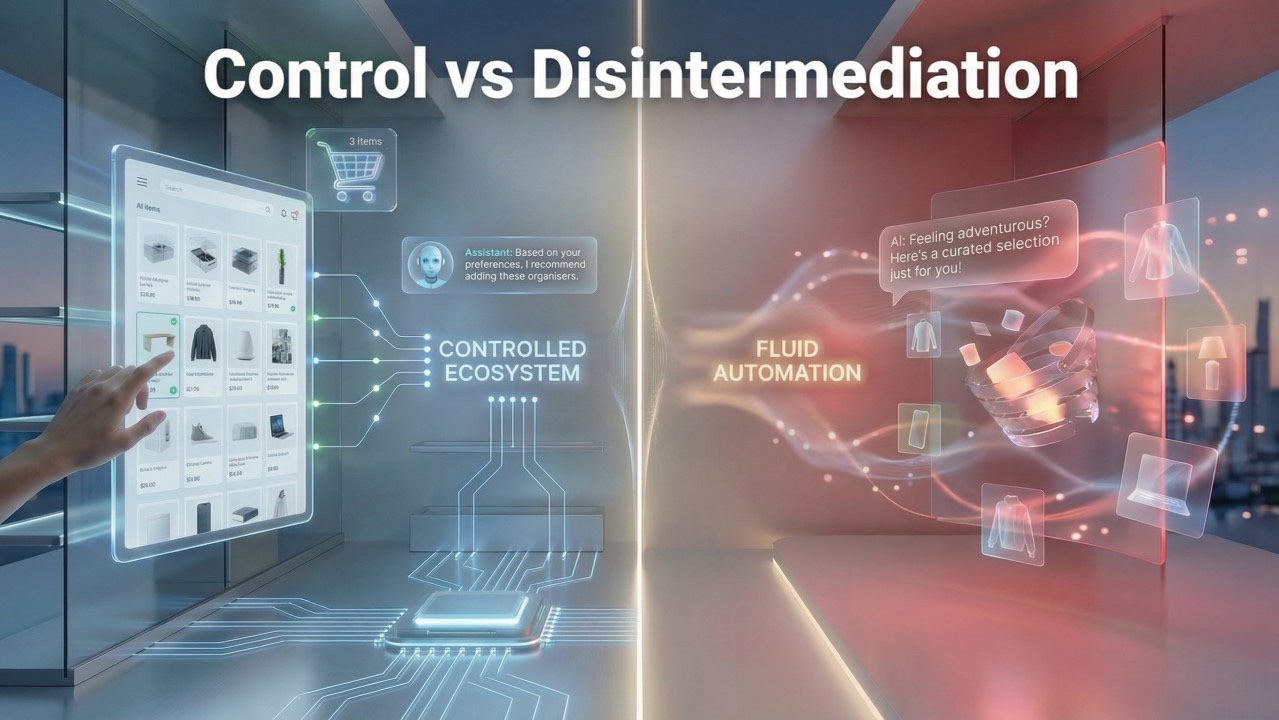
For years, loyalty programs have been built on the assumption that the brand owns the moment of purchase.
Agentic commerce breaks that assumption.
Customers are no longer browsing, comparing, and deciding inside your app or on your website. They are asking AI to do it for them. The interface is no longer the battleground. The new battle ground is the decision engine.
That shift has a concrete consequence: loyalty is at risk of being disintermediated.
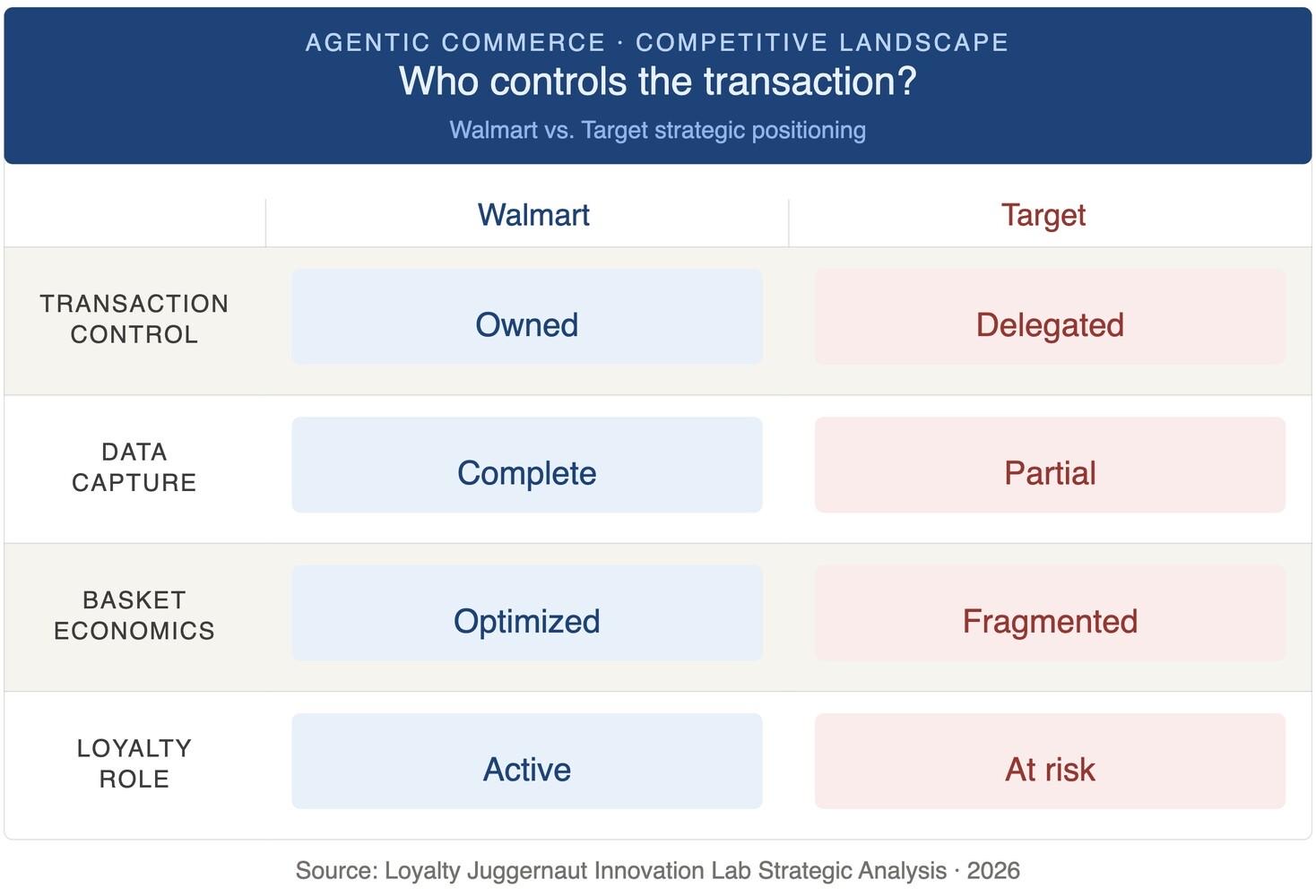
We are starting to see this play out across two of the world’s most sophisticated retailers: Walmart and Target. Both are leaning into AI-powered shopping. Both feel forward-looking. But they are taking fundamentally different approaches, and the implications for loyalty are not the same.
Walmart tested embedded checkout inside AI experiences. Conversion dropped materially. Their response was not to double down… it was to pivot. They repositioned AI as a discovery layer, helping customers find and evaluate products, while keeping the transaction firmly inside Walmart’s owned ecosystem.
Target is moving in the opposite direction. Shopping, selection, and transaction increasingly happen inside the assistant itself.
When the transaction moves into an AI environment, three things happen:
- The assistant owns the recommendation, not the retailer, not the loyalty program.
- The assistant shapes the basket, not merchandising, not promotions.
- And the assistant captures the intent signal not the brand.
The result is subtle but significant: loyalty does not disappear, it just becomes invisible to the decision.
Without visibility into behavior, without a role in shaping the moment of influence, loyalty loses its ability to prove value. It shifts from a growth engine to a cost center.
This is where Walmart’s approach becomes strategically interesting.
By keeping the transaction inside its own environment, Walmart preserves the moment of influence. Loyalty systems can still intervene in real time… guiding offers, shaping baskets, optimizing the value exchange. First-party data remains intact. Attribution holds. Personalization continues to compound.
Most importantly, loyalty stays in its proper role: not as a post-purchase reward mechanism, but as a decisioning layer.
Walmart’s deliberate architecture.
When you control the transaction, you control the economics. When you control the economics, you can optimize them. The structural benefits are already visible: stronger basket construction, higher engagement, tighter alignment between customer value and business outcomes.
The contrast is sharpening. Walmart is protecting the relationship, and the economics that come with it. Target is expanding into new channels, but potentially ceding control of the decision itself. Neither is inherently wrong. They are optimizing for different things.
For loyalty leaders, the implication runs deeper than channel strategy.
Loyalty must evolve from a program that rewards behavior to a system that shapes it: an enterprise performance engine. That means being present in the decision layer, not just the channel. It means exposing value in ways that AI systems can recognize and act on. And it means maintaining control of at least one defining moment in the journey: checkout, wallet, or identity.
The future of commerce will be agentic. The question is not whether AI will sit between you and your customer. The question is whether your loyalty strategy still has any bearing on what happens when it does.